
SUMMARY
- A vehicle can look fully repaired while its safety systems after a collision still have unresolved concerns, because exterior appearance alone cannot confirm that technicians properly restored the structural, mechanical, electronic, and restraint systems.
- Proper collision repair involves more than replacing damaged panels and matching paint, and depending on the vehicle, technicians may need to inspect structural components, airbags, seat belts, steering, suspension, brakes, cameras, and radar sensors.
- Manufacturer repair procedures identify the vehicle-specific inspection, replacement, calibration, and verification requirements that apply to each repair.
- Pre-repair and post-repair diagnostic scans serve different purposes, and while scans can identify electronic faults, they cannot replace physical inspections or required ADAS calibration.
- A vehicle may also need ADAS calibration even when no dashboard warning light appears, and the applicable manufacturer procedure determines whether calibration is necessary.
- Airbags and seat belt systems require careful evaluation after certain collisions, and a warning light turning off does not prove that the shop met every restraint-system requirement.
- Structural measurements, alignment records, diagnostic reports, and calibration documentation can help show which repair procedures the shop completed.
- Before accepting a repaired vehicle, drivers can ask the repair facility to explain the safety-related work performed and identify any unresolved concerns.
- All County Collision uses a structured repair process that includes diagnostic scanning, disassembly, post-repair scanning, in-house ADAS calibration when manufacturer procedures require it, and final inspection.
- All County Collision provides collision repair, auto body repair, and ADAS calibration for Oxford, The Villages, Wildwood, Summerfield, and nearby Central Florida drivers at 12027 US-301, Oxford, FL 34484, United States.
Introduction
Picking up your vehicle after an accident can be a relief.
The shop has repaired the damaged bumper.
The paint matches.
The doors close properly, and the vehicle looks much like it did before the collision.
But one important question remains:
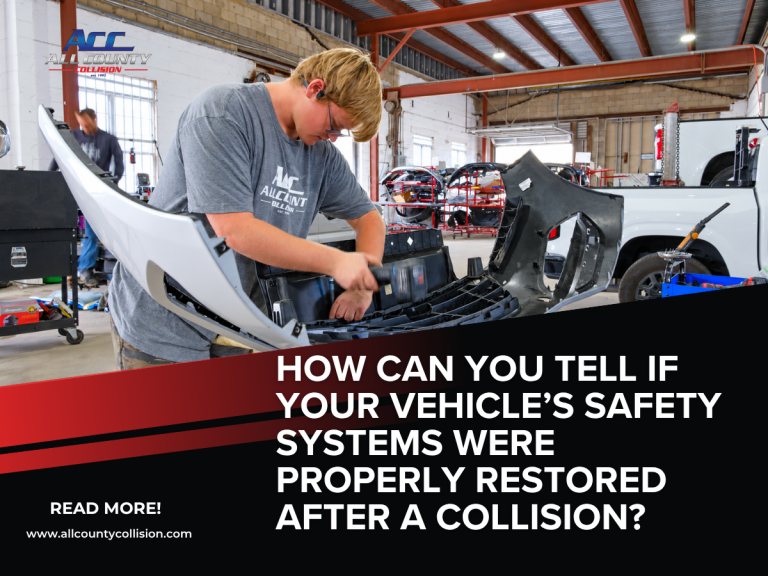
How do you know the shop properly restored your vehicle’s safety systems after a collision?
Modern vehicles contain several systems designed to protect occupants, maintain vehicle control, and assist the driver.
These can include:
- Structural crash-management components
- Airbags and seat belt pretensioners
- Steering and suspension
- Brakes and electronic stability control
- Cameras and radar sensors
- Electronic control modules
Some of these systems are visible.
Others sit behind body panels, inside the passenger compartment, or within electronic modules.
An impact could affect a radar sensor behind a bumper, a seat belt pretensioner, or a suspension mounting point without leaving a problem a driver can easily see.
That is why professional collision repair involves inspection, manufacturer repair research, appropriate repairs, and verification.
For drivers in Oxford, The Villages, Wildwood, Summerfield, and nearby Central Florida communities, understanding these steps makes it easier to ask informed questions before accepting a repaired vehicle.
All County Collision’s collision repair process is a useful starting point for understanding how technicians assess, repair, and verify accident damage.
Which Safety Systems After a Collision Should Be Inspected?
It depends on the vehicle, the severity of the collision, the impact location, and manufacturer procedures.
Systems that may need attention include:
- Structural components, which manage collision forces and provide mounting locations for critical parts
- Airbags and seat belts, which may require inspection, diagnostic evaluation, or replacement
- Steering and suspension, which affect handling, alignment, and stability
- Braking systems, including brake lines, sensors, and hydraulic components
- Advanced Driver Assistance Systems (ADAS), including cameras and radar sensors
- Electronic control systems, which may store diagnostic information after an impact
Not every collision affects all of these systems.
A qualified repair facility determines which inspections and procedures apply to the specific vehicle and accident, so technicians can identify the safety systems after a collision that need work before repairs begin.
Why Can’t You Judge Safety Systems After a Collision by Appearance Alone?
Because cosmetic appearance does not show whether underlying components meet manufacturer requirements.
A smooth finish and even panel gaps tell you the shop restored the exterior.
However, they do not tell you whether a radar bracket sits in alignment, whether anyone evaluated a pretensioner, or whether a suspension mounting point is in its correct position.
That is why verifying safety systems after a collision matters as much as the visible repair.
Can a Vehicle Look Perfect but Still Have Hidden Safety Damage?
Yes.
Hidden damage can include:
- Bent structural mounting points
- Damaged reinforcement components
- Misaligned radar brackets
- Damaged wiring
- Suspension deformation
- Compromised seat belt components
- Electronic system faults
Many of these components sit behind exterior panels, trim, carpeting, or other assemblies.
Not every accident causes hidden damage, but technicians should still evaluate the possibility based on the impact and vehicle-specific requirements.
You can learn more in our guide on why hidden damage is common after a car accident.
How Do Technicians Find Hidden Damage to Safety Systems After a Collision?
Depending on the accident, the process may involve:
- Initial visual inspection
- Partial disassembly
- Damage measurements
- Mechanical inspection
- Diagnostic scanning
- Manufacturer repair procedure research
At All County Collision, pre-washing, diagnostic scanning, and disassembly are part of the early production stage.
Then, when technicians find additional damage during disassembly, they update the repair plan.
A good question to ask is whether the facility inspected the areas behind the visibly damaged components, since that is where many safety systems after a collision sit out of sight.
Why Are OEM Repair Procedures Important for Vehicle Safety?
Original Equipment Manufacturer (OEM) procedures provide instructions for inspecting and repairing specific vehicles.
Depending on the vehicle, they can include:
- Structural repair requirements
- Component replacement criteria
- Welding and joining methods
- Corrosion protection requirements
- Restraint-system inspection procedures
- Diagnostic scanning requirements
- ADAS calibration procedures
- Final verification steps
These procedures are central to restoring safety systems after a collision correctly, because they tell technicians exactly what the manufacturer requires for each vehicle.
The I-CAR Repairability Technical Support portal provides resources related to manufacturer collision repair information.
You can also read more about why OEM repair procedures matter after a crash.
Why Can’t Every Vehicle Be Repaired the Same Way?
Manufacturers use different materials, structures, sensors, and electronic systems.
A procedure that is appropriate for one vehicle may not be appropriate for another.
Manufacturers also publish updated repair information over time, so procedures can change.
To confirm the shop considered OEM procedures, ask whether it researched the applicable procedures and which major safety-related operations the vehicle required.
How Can You Tell Whether Structural Damage Was Properly Repaired?
Structural damage can affect the vehicle’s geometry, strength, and component mounting locations.
Depending on the collision, affected areas can include:
- Front and rear rails
- Crossmembers
- Pillars
- Rocker structures
- Floor structures
- Suspension mounting points
- Reinforcement components
Technicians may use specialized measuring equipment to compare vehicle dimensions with manufacturer specifications, because other safety systems after a collision depend on the structure being in the right position.
Not every vehicle needs structural measurement.
The need depends on the damage assessment and applicable repair procedures.
If the shop performed structural repairs, ask whether it can provide measurement records or other verification documentation.
For more background, see our article on what frame damage is and how it is repaired.
Can Panel Gaps Confirm the Structure Was Repaired Correctly?
No.
Panel alignment may provide visual clues.
However, it cannot establish that the repair met every structural dimension and requirement.
Structure is the foundation for many other safety systems after a collision, so it deserves measured verification when the damage calls for it.
How Are Airbag Safety Systems Checked After a Collision?
Airbags are part of a vehicle’s Supplemental Restraint System (SRS).
Depending on the vehicle and collision, deployment may trigger requirements involving:
- Airbag modules
- Seat belt pretensioners
- Impact sensors
- Electronic control modules
- Wiring
- Interior components
Technicians generally replace a deployed airbag module according to manufacturer procedures.
Technicians must also evaluate other components using the applicable instructions, which is why you should never judge airbag-related safety systems after a collision by appearance alone.
The National Highway Traffic Safety Administration provides general vehicle safety information.
Do Restraint Safety Systems After a Collision Need Inspection if the Airbags Did Not Deploy?
They may.
Nondeployment does not automatically eliminate the need for restraint-system inspection.
Some manufacturers specify inspections after certain impacts regardless of whether an airbag deployed.
A diagnostic scan alone cannot confirm everything is safe, because scanning provides electronic information but cannot replace required physical inspections.
Ask whether the shop completed the applicable restraint-system inspection and repair procedures.
Why Should Seat Belt Safety Systems Be Inspected After a Collision?
Seat belts are essential occupant protection components.
A collision can affect a seat belt without leaving visible tears.
Collision forces or pretensioner activation can affect certain restraint components.
A pretensioner tightens the belt under specified crash conditions.
Depending on the vehicle and accident, parts that may require replacement include:
- Belt assemblies
- Pretensioners
- Buckles
- Retractors
- Related restraint components
Can a Seat Belt Retract Normally and Still Need Attention?
Possibly.
Normal movement alone does not confirm that the repair met every manufacturer inspection requirement.
Ask whether technicians evaluated the seat belts and related restraint components according to manufacturer procedures.
What Is a Pre-Repair Diagnostic Scan?
A pre-repair diagnostic scan retrieves available information from vehicle electronic systems before repairs begin.
It may identify:
- Sensor faults
- Communication errors
- Restraint-system trouble codes
- ADAS-related faults
- Other electronic system concerns
Scanning helps identify electronic issues that may not be apparent during a visual inspection.
It also documents the vehicle’s electronic condition during repair planning and gives technicians a baseline for checking safety systems after a collision later.
Not every diagnostic trouble code means collision damage, since some codes may relate to preexisting conditions or other causes.
A pre-repair scan also cannot detect all physical damage or every sensor alignment issue.
Our article on the role of vehicle diagnostics in modern collision repair explains this in more detail.
What Is a Post-Repair Diagnostic Scan?
A post-repair scan retrieves electronic system information after technicians complete the repairs.
It helps identify remaining faults or electronic issues that need attention.
Depending on the vehicle, technicians may review:
- Active fault codes
- Relevant stored codes
- System communication
- Repair-related electronic concerns
All County Collision incorporates post-repair scanning into its repair process when applicable, before final delivery, as one part of verifying safety systems after a collision.
Does a Clear Post-Repair Scan Prove Safety Systems After a Collision Are Fully Restored?
No.
A post-repair scan is one verification step, not a comprehensive safety certification.
A vehicle can show no fault codes and still need calibration, because some calibration requirements depend on the repair operations performed rather than on detected faults.
Ask whether the vehicle required post-repair diagnostic scanning and whether the shop performed and documented it.
Is an ADAS Diagnostic Scan the Same as Calibration?
No.
This distinction is especially important for vehicles with driver-assistance technology.
A diagnostic scan retrieves available information from electronic systems.
ADAS calibration aligns or configures applicable cameras and sensors according to manufacturer procedures.
A vehicle may have no relevant trouble codes while still requiring calibration after a specified repair, so a scan alone does not confirm that ADAS-related safety systems after a collision are ready for the road.
What Repairs Can Trigger ADAS Calibration?
Depending on the vehicle, these repairs may require calibration:
- Windshield replacement
- Camera replacement
- Radar sensor replacement
- Certain bumper repairs
- Suspension or alignment work
- Other manufacturer-specified operations
All County Collision performs ADAS calibration in-house when manufacturer procedures require it.
How Can You Verify That ADAS Calibration Was Completed?
Calibration should follow the procedure required for the specific vehicle.
Common approaches include:
- Static calibration, generally performed with the vehicle stationary using specified equipment and targets
- Dynamic calibration, generally performed under specified driving conditions
- Dual calibration, which involves both static and dynamic procedures
Finally, the vehicle manufacturer determines which method the vehicle needs.
Depending on the equipment and procedure, documentation may include:
- A calibration completion report
- System identification
- Procedure outcome
- Related diagnostic information
Ask which systems required calibration and whether documentation of the completed procedures is available, since calibration records are some of the clearest proof that the shop addressed safety systems after a collision.
Does Successful Calibration Mean ADAS Will Prevent an Accident?
No.
Driver-assistance technologies have limitations and do not replace attentive driving.
Calibration helps the system operate according to manufacturer specifications, but no system can prevent every crash.
Can ADAS Be Misaligned Without a Dashboard Warning Light?
Yes.
Some sensor alignment conditions may not produce an obvious warning.
A system may not detect every physical alignment issue as an electronic fault.
ADAS features may also appear to function while not meeting manufacturer specifications.
This is one reason warning lights are not a reliable way to judge safety systems after a collision.
Should You Test Automatic Emergency Braking Yourself?
No.
Do not attempt to trigger emergency braking or other collision-avoidance features in traffic.
The appropriate verification method is to follow manufacturer procedures using qualified repair professionals and the required equipment.
The Insurance Institute for Highway Safety explains common driver-assistance technologies and their limitations.
How Do Steering and Suspension Repairs Affect Vehicle Safety?
Steering and suspension components influence handling, tire contact with the road, and vehicle control.
Depending on the collision, damage may include:
- Bent control arms
- Damaged tie rods
- Damaged steering components
- Bent struts
- Damaged mounting points
- Wheel alignment changes
A vehicle can drive straight and still have suspension damage, because apparent driving behavior does not rule out every mechanical problem affecting safety systems after a collision.
Does Every Collision Require a Wheel Alignment?
No.
Wheel alignment involves measuring and adjusting specified wheel angles.
Whether a vehicle needs one depends on the impact, the affected components, and manufacturer instructions.
If the shop performed an alignment, ask for the before-and-after alignment measurements.
Alignment can also affect some driver-assistance systems, which is another reason to treat steering, suspension, and ADAS as connected safety systems after a collision.
Should Brake Safety Systems Be Inspected After a Collision?
They may need inspection when the impact involves relevant areas.
For example, the impact might affect:
- Brake hoses
- Brake lines
- Wheel speed sensors
- Brake hardware
- Electronic braking components
Take these warning signs seriously:
- Brake warning lights
- Fluid leaks
- Unusual pedal behavior
- Pulling during braking
- Unexpected braking noises
Can a Short Test Drive Confirm Brake Safety?
No.
A short drive does not replace professional inspection.
If braking feels abnormal after repairs, stop driving when it is safe to do so and arrange a professional evaluation.
Braking problems can present immediate safety risks, so brakes belong on any checklist of safety systems after a collision.
Can Bumper Repairs Affect Safety Systems After a Collision?
Yes.
Modern bumper assemblies may contain or conceal several components, including:
- Reinforcement structures
- Energy-absorbing components
- Radar sensors
- Parking sensors
- Wiring
- Mounting brackets
Minor exterior damage can hide other problems, because the visible bumper cover may not reveal what is behind it.
Not every bumper repair requires sensor calibration, since requirements depend on the vehicle and repair operations.
Some manufacturers also restrict certain repairs, coatings, or materials in sensor-related areas.
Ask whether the facility inspected the relevant bumper components and reviewed the applicable sensor procedures, because a bumper repair can touch several safety systems after a collision at once.
Why Does Windshield Replacement Sometimes Require Camera Calibration?
Some vehicles use a forward-facing camera mounted near the windshield.
Removal or installation can change the camera’s position or its optical relationship to the glass.
Not every vehicle has a windshield-mounted ADAS camera, so equipment varies.
Replacement glass must meet applicable vehicle specifications, because it can affect camera performance.
Manufacturer instructions, not the presence or absence of warning lights, should determine whether calibration is necessary for camera-based safety systems after a collision.
What Role Does Corrosion Protection Play in Collision Repair?
Collision repairs can disturb factory coatings or protective materials.
Operations that may affect protection include:
- Welding
- Panel replacement
- Metal straightening
- Surface preparation
- Seam repair
Depending on the manufacturer’s procedure, required materials may include:
- Primers
- Sealers
- Corrosion-resistant coatings
- Cavity protection materials
Improperly protected repaired areas may develop corrosion over time, which can affect long-term vehicle condition.
Ask whether the repair plan included applicable corrosion protection procedures.
What Is a Post-Repair Quality Control Inspection?
Quality control is the review of completed work before the shop delivers the vehicle.
Depending on the repair, checks may cover:
- Exterior fit and finish
- Door and panel operation
- Lighting
- Mechanical components
- Electronic systems
- Required calibrations
- Remaining diagnostic concerns
- Repair documentation
Quality control is broader than a post-repair scan, since scanning is just one part of verification.
The checklist also depends on the damage and completed repairs.
All County Collision uses multiple checkpoints throughout its repair process and performs a final inspection before delivery.
See our article on why post-repair safety inspections matter for more detail.
What Documents Should You Receive After Collision Repairs?
Documentation helps you understand the completed work.
Depending on the repair, records may include:
- Final repair invoice, identifying the repairs and charges
- Supplemental estimates, documenting additional damage or operations technicians found during repairs
- Structural measurement records, when the repair required measurements
- Alignment reports, with before-and-after measurements when the shop performed an alignment
- Diagnostic reports, showing relevant electronic system information
- Calibration documentation, identifying the systems calibrated and the outcome
- Warranty information, which you should review for its terms and exclusions
Not every repair requires every document.
Ask which records apply to your vehicle and which ones document work on safety systems after a collision.
All County Collision offers a limited lifetime warranty on qualifying paintwork and body or structural workmanship for as long as you own the vehicle, subject to the warranty’s terms, while the applicable manufacturer or supplier warranty covers parts and materials.
Can Insurance Estimates Leave Out Safety-Related Procedures?
An initial insurance estimate may not identify every required operation.
Some damage becomes apparent only after disassembly or additional inspection.
When that happens, a supplement documents the additional repair operations, parts, or costs.
As a result, ADAS calibration can appear on a supplement when technicians identify it during repair planning or manufacturer procedure research.
Coverage and payment still depend on the policy and claim circumstances.
Ask the repair facility to explain any important differences between the insurance estimate and the final repair plan.
You can learn more about what a supplement is in collision repair, and the Florida Department of Financial Services offers insurance consumer resources.
Can Proper Repairs of Safety Systems After a Collision Help Preserve Vehicle Value?
They can help preserve a vehicle’s physical condition and provide documentation for future buyers.
But professional repair does not guarantee pre-accident resale value.
A vehicle may still experience diminished value because of its accident history, even when the shop completes the repairs properly.
Records that may be useful when selling include:
- Repair invoices
- Structural measurement reports
- Diagnostic records
- ADAS calibration documentation
- Maintenance records
Proper repair and resale value are separate considerations, and both deserve attention after a collision.
What Warning Signs of Safety System Problems Should You Watch for After a Collision?
Pay attention to unusual vehicle behavior after repairs, since problems with safety systems after a collision sometimes show up only once you are back on the road.
Electronic warning signs include:
- Airbag warning lights
- Brake warning lights
- Stability control warnings
- ADAS malfunction messages
- Other unexplained system alerts
Mechanical warning signs include:
- Pulling to one side
- Unusual steering resistance
- Abnormal braking behavior
- Excessive vibration
- New suspension noises
Other concerns can include doors that do not operate properly, water intrusion, loose trim, unusual wind noise, or malfunctioning lights.
What Should You Do if a Safety Warning Appears After Repairs?
Contact the repair facility and describe the concern.
Not every symptom means the collision repair was incorrect, so a professional should diagnose the cause.
If the issue involves steering, braking, restraints, or another critical safety system after a collision, avoid driving until a professional evaluates the vehicle.
How Does a Structured Collision Repair Process Protect Safety Systems?
A structured process creates opportunities to identify and address accident-related damage.
At All County Collision, the process generally includes:
- An in-person inspection or photo estimate
- Pre-wash, diagnostic scanning, and disassembly
- Repair planning, with updates when technicians find additional damage
- Parts ordering, prioritizing OEM-manufactured parts when possible
- Structural, mechanical, and body repairs
- Refinishing and reassembly
- Post-repair scanning and in-house ADAS calibration when required
- Quality checkpoints and final inspection before delivery
You can review each stage on the collision repair process page.
How Can You Choose a Collision Shop That Prioritizes Safety Systems?
When evaluating a repair facility, ask about:
- Manufacturer repair information: Does the shop research vehicle-specific requirements?
- Technician training: What training is relevant to the work the shop performs?
- Equipment: Does the facility have the necessary repair and measuring equipment?
- Diagnostic capabilities: How are electronic concerns identified and documented?
- ADAS calibration: How does the shop determine which calibrations the vehicle needs?
- Communication: Will the facility explain hidden damage and estimate changes?
- Documentation: Can the shop provide relevant records of completed work?
These questions help you evaluate how a shop handles safety systems after a collision rather than relying only on price or appearance.
Our guide to the signs you’ve found a quality auto body shop covers more of what to look for.
What Questions Should You Ask About Safety Systems After a Collision Before Pickup?
Consider asking:
- Were manufacturer repair procedures followed?
- Did technicians find hidden damage during disassembly?
- Were the airbags and seat belts evaluated?
- Were pre-repair and post-repair diagnostic scans performed?
- Was ADAS calibration required, and for which systems?
- Were structural measurements necessary?
- Were steering and suspension components inspected?
- Was wheel alignment performed?
- Were brake components inspected where needed?
- Were corrosion protection procedures included?
- Which repair records apply to my vehicle?
- Are there any unresolved safety concerns?
You do not need to understand every technical procedure yourself.
You should understand whether the repair facility identified the relevant requirements and completed them.
Why Do I-CAR Training and OEM Certifications Matter for Safety Systems After a Collision?
Modern vehicles combine advanced materials, crash structures, restraint systems, and driver-assistance technology.
Repairing safety systems after a collision correctly requires current training and access to manufacturer repair information.
All County Collision maintains I-CAR Gold Class and I-CAR Platinum recognition as part of its technician and facility training.
The shop also holds manufacturer certifications that support a disciplined repair process and stronger repair planning.
Learn more about All County Collision’s OEM certifications.
How Does All County Collision’s Repair Process Support Safety Verification?
All County Collision builds its process around identifying damage early and verifying safety systems after a collision before delivery.
That includes:
- Diagnostic scanning and disassembly early in production
- Updated repair plans when technicians find hidden damage
- OEM-aware repair planning and manufacturer procedures
- OEM-manufactured parts prioritized when possible
- Post-repair scanning when applicable
- In-house ADAS calibration when manufacturer procedures require it
- Quality checkpoints and final inspection
The shop also works directly with insurance companies and keeps customers informed during repairs.
Why Choose All County Collision for Collision Repair in Oxford, FL?
All County Collision has been family-owned since 1992, and Ryan DeMarco took over the business in 2016.
Drivers in Oxford, The Villages, Wildwood, and Summerfield who want their safety systems after a collision handled carefully can choose a shop that:
- Follows a structured, documented collision repair process
- Performs ADAS calibration in-house when required
- Maintains I-CAR Gold Class and I-CAR Platinum recognition
- Works directly with insurance companies
- Offers auto body repair and fleet repair as well as collision repair
Drivers can learn more on the All County Collision Oxford location page.
Frequently Asked Questions
How can I tell if the safety systems after a collision were properly restored?
Ask which manufacturer-required inspections, repairs, diagnostic procedures, and calibrations the shop completed. Relevant documentation can help verify the work, but appearance alone cannot establish vehicle safety.
Can a vehicle have hidden damage after collision repairs?
Hidden damage is often identified during disassembly and inspection, and appropriate repair planning helps address it. If new concerns appear after delivery, request a professional evaluation.
Does a post-repair diagnostic scan prove all safety systems after a collision are working?
No. Scanning retrieves electronic information but does not replace physical inspection, structural measurement, or required ADAS calibration.
Is ADAS calibration always required after a collision?
No. Requirements depend on the vehicle, affected systems, and repair operations, and manufacturer procedures determine when calibration is necessary.
Should airbags and seat belts be inspected even if they did not deploy?
Certain collisions may require restraint-system inspection even without deployment. The applicable manufacturer procedures determine the required checks and replacements.
What documents should I request after collision repair?
Request the final repair invoice and any relevant structural measurement records, alignment reports, diagnostic scan results, calibration documentation, and warranty information.
What should I do if a safety warning light appears after repairs?
Contact the repair facility promptly. If the warning concerns a critical safety system, avoid driving until a professional evaluates the vehicle.
Where can I get collision repair and ADAS calibration in Oxford, FL?
Oxford drivers can contact All County Collision at 12027 US-301, Oxford, FL 34484, United States for collision repair, auto body repair, and in-house ADAS calibration, serving Oxford, The Villages, Wildwood, Summerfield, and nearby communities.
Get Your Vehicle’s Safety Systems Properly Restored in Oxford, FL
A vehicle’s exterior appearance does not show whether the repair met every safety-related requirement.
After a collision, the repair may need to address:
- Structural components
- Steering and suspension
- Brakes
- Airbags and seat belts
- Electronic modules
- Cameras and radar sensors
The right work on safety systems after a collision depends on the vehicle, the accident damage, and manufacturer procedures.
That is why the right question at pickup is not simply:
“Does my car look repaired?”
A better question is:
“Were my vehicle’s safety systems after a collision inspected, repaired, calibrated, and verified according to the manufacturer’s requirements?”
All County Collision uses diagnostic scanning, OEM-aware repair planning, in-house ADAS calibration, and final quality inspection to help restore today’s complex vehicles.
If your vehicle has been in an accident and you want its safety-related repairs handled carefully, visit:
All County Collision
12027 US-301, Oxford, FL 34484, United States
Learn more about collision repair, review the collision repair process, explore ADAS calibration, or contact All County Collision to have your vehicle evaluated.
Disclaimer: This article provides general educational information and does not replace vehicle-specific manufacturer procedures or professional safety inspections. Collision damage, repair requirements, and ADAS calibration needs vary by vehicle. If you suspect a critical safety system is malfunctioning, avoid driving until a professional evaluates the vehicle.
